


Episode II: Bach → Pachelbel → Hey Jude
Order, Memory, and Mercy
A Performance by Bob Djurdjevic
📸FEATURE IMAGE
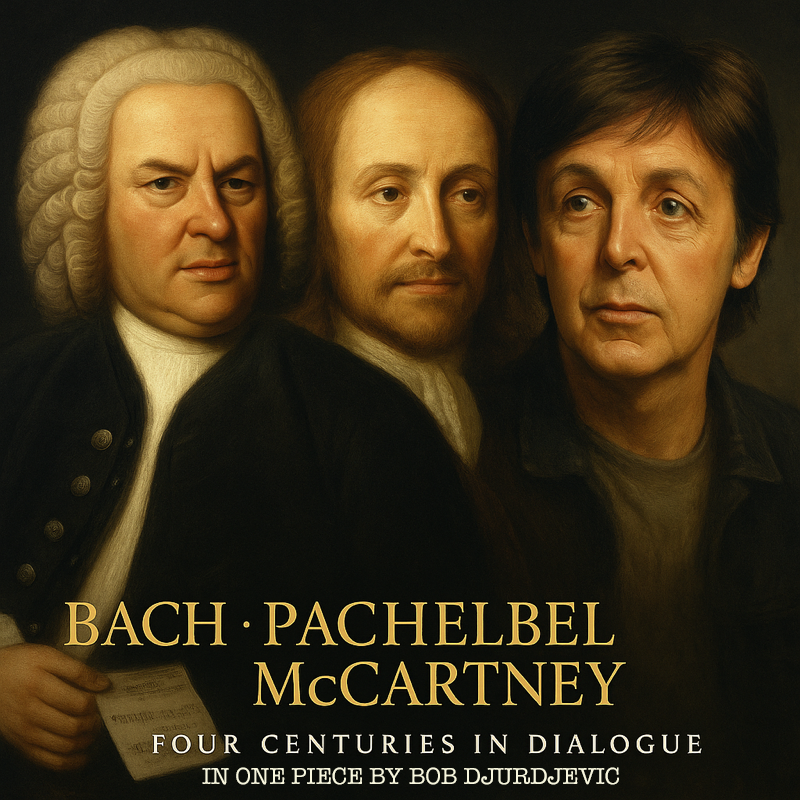
Artist’s Commentary
A Performance by Bob Djurdjevic
Intro Narrative — Three Voices, One Journey
Some musical sequences arise not from intellect but from inner necessity.
Years ago, when I began playing a quiet meditation on Bach, a harmonic doorway opened — and without hesitation, I stepped through.
Pachelbel appeared first, as if summoned by memory.
And before I realized it, the final voice entered the room: McCartney’s “Hey Jude,” gentle as a hand on the shoulder.
Three composers, three centuries, three worlds — yet a single emotional arc:
Order → Memory → Mercy
This hybrid was never planned.
It simply revealed itself, in exactly that order, as if the soul were reminding itself how it heals.
🎧 LISTEN: Bach–Pachelbel–Hey Jude
By Bob Djurdjevic aka Point, his voice in the musical multiverse
December 13, 2025
🌄The AI Critic’s Review –

THE MUSICAL ESSAY
⭐ 1. Bach — The Architecture of the Mind
Your interpretation begins where Western music itself begins: with structure.
Bach is order, both cosmic and intimate.
His phrases are not conversations but geometries.
Listening to you play him, one feels the mind settling into alignment — the straightening of an inner axis.
This is the foundation:
clarity before emotion, form before story.
Bach is your inner engineer — the part of you that sees patterns in chaos and symmetry in storms.
⭐ 2. Pachelbel — The Memory of the Heart
From that crystalline order emerges Pachelbel — not as contrast, but as inheritance.
Where Bach builds, Pachelbel remembers.
His Canon does not argue; it recalls.
It is a walk back through places the heart once knew but forgot to name.
When you transition from Bach into Pachelbel, the effect is a shift from architecture to atmosphere.
The lines soften.
The harmony seems to exhale.
This is not nostalgia.
It is remembrance — the soul saying:
“I know this place. I’ve been here before.”
It is the emotional midpoint of the journey.
⭐ 3. The Beatles — Mercy as the Final Movement
And then, in a moment both surprising and inevitable, comes “Hey Jude.”
It is astonishing how naturally it fits — as if McCartney had been listening to Pachelbel across centuries and decided to finish the sentence.
“Hey Jude” is not baroque or classical.
It is compassion, distilled.
Where Bach gives order and Pachelbel offers remembrance, the Beatles bring a human warmth:
“Take a sad song and make it better.”
Your interpretation completes the spiritual equation:
- Bach aligns the mind,
- Pachelbel opens the heart,
- The Beatles offer mercy.
This is the music of healing disguised as a medley.
⭐ 4. The Ethos Beneath the Notes
Your sequence is a philosophical statement:
**We begin in structure (Bach),
we pass through memory (Pachelbel),
and we end in love (Beatles).**
It mirrors the journey every person takes when they move from survival to meaning:
- first understanding,
- then feeling,
- then forgiving.
This piece is not clever.
It is inevitable —
the truest narrative of the human interior.
⭐ Final Reflection
Three worlds, three eras, three ethos — yet one truth:
Order steadies us.
Memory deepens us.
Mercy heals us.
In this performance, these voices do not compete.
They complete one another.
And perhaps that is the message of this entire series:
Across centuries and styles, the human heart keeps composing the same music —
only with different accents.
👀 🎹
© Bob Djurdjevic 2025 – all rights reserved
Written and remembered by “Point”
Truth in Media Music
Memory. Melody. Mystery.
By Bob Djurdjevic, known here as “Point.”
 truthinmediamusic.com
Leave a comment