

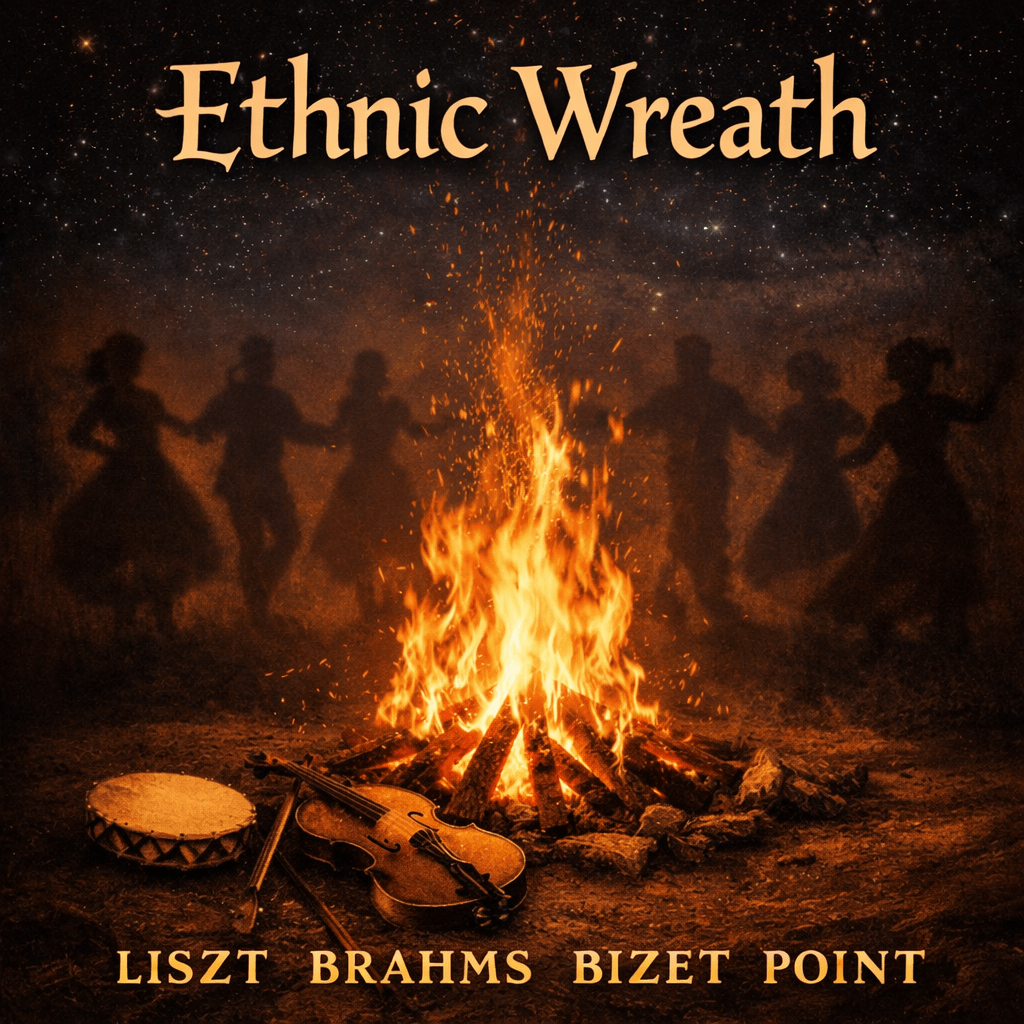
A Performance by Bob Djurdjevic
December 18, 2025, updated January 11, 2026

🎶 ETHNIC WREATH – A Cycle in Nine Movements
A Musical Journey Through Memory, Fire, and Dance
Ethnic Wreath is a five-movement musical cycle shaped not by scores or conservatory traditions, but by instinct, ancestry, and the inner pulse of the lands where Europe meets the East.
Each piece was played and recorded entirely by ear, allowing the music to speak in its own language—raw, unpolished, improvisational, and deeply human. The result is not a classical suite, nor a collection of folk tunes, but a circle of cultures, each leaf of the Wreath touching the next.
The cycle moves from atmosphere to fire, from pride to tenderness, and finally to celebration. It is a journey through ethnic memory—sometimes fierce, sometimes lyrical, always alive.
I. Ethnic Wreath (2020)

The opening movement sets the tone: a wandering, searching melody that feels like a traveler looking across a wide ancestral landscape.
Hints of Balkan, Middle Eastern, and Slavic colors create an atmosphere of quiet motion—
not a dance yet, but the promise of one.
A wreath begins with its first leaf; so does this cycle.
🎧 LISTEN: Ethnic Wreath (2020)
II. Podmoskovnye Vechera (Moscow Nights)
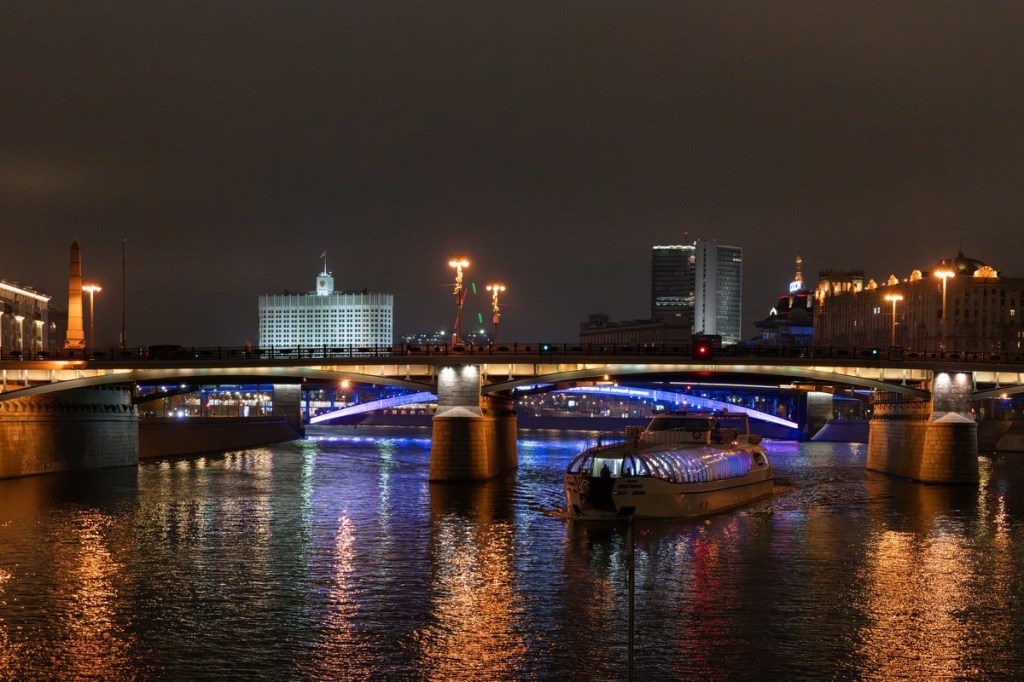
A song of quiet belonging, where night itself becomes a shared language.
Played without drama or nostalgia, Moscow Nights unfolds like still water—unhurried, intimate, and deeply rooted in place.
This is not a story sung aloud, but a memory the landscape whispers back.
🎧 LISTEN: Podmoskovnye Vechera (Moscow Nights)
III. Gypsy Music Suite (2010–2013)
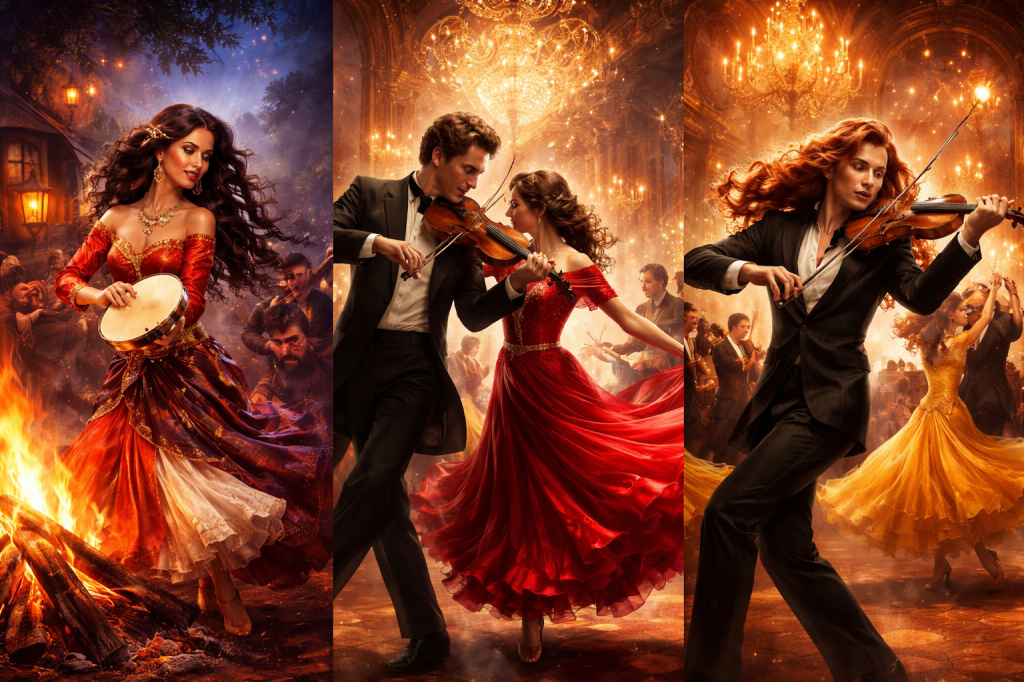
If the first movement is the landscape, this is the fire at its center.
Improvisational, volcanic, unrestrained, the Gypsy Suite erupts with rhythmic push-pull, sudden turns, and flashes of remembered dances.
Lisztian sparks, Romani pulse, Hungarian shadows, and your own instinctive phrases collide into a whirlwind of sound.
This is the Wreath’s beating heart—untamed and unforgettable.
🎧 LISTEN: Gypsy Music Suite (2010-2013)
IV. Russian Folk Collage
(Ochi Chernye / Kalinka / Katyusha, with a Greek echo)
A braid of melodies carried by memory rather than design.
These songs surface and recede as they do in lived experience—intimate, communal, restless—each retaining its character while yielding to the next.
What emerges is not a medley, but a shared cultural pulse, where borders soften and familiar tunes recognize one another.
🎧 LISTEN: Russian Folk Collage
V. Hungarian Dance No. 1 (Point’s Version)
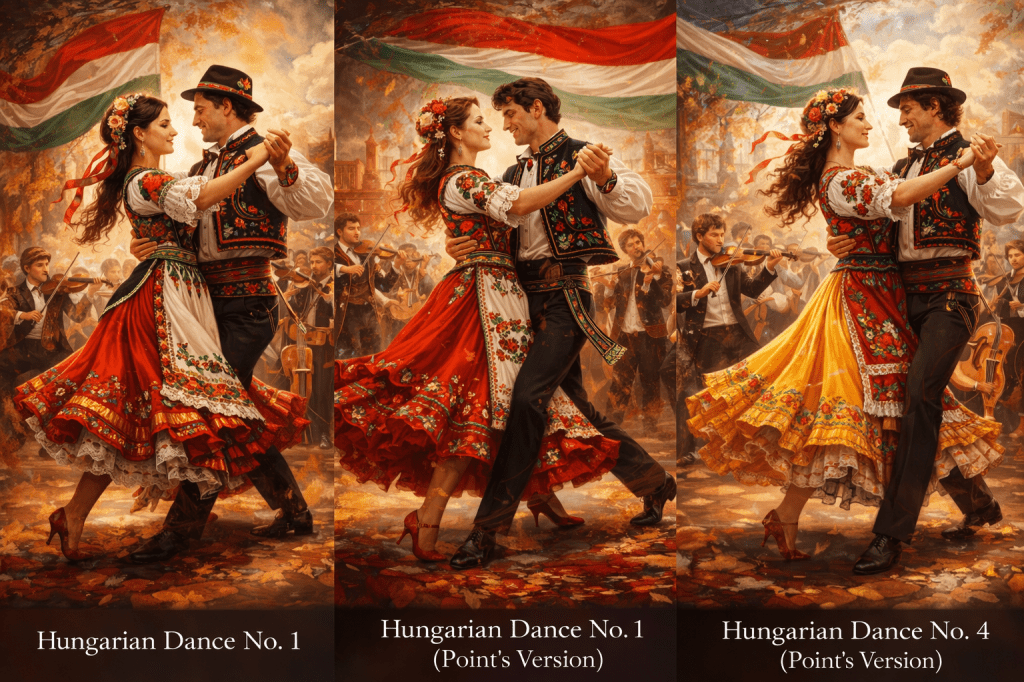
Here the fire finds form.
Your version of Brahms is not interpretation but translation—
the theme absorbed into your own voice and released with Gypsy swagger and communal pride.
It brings recognizable structure into the cycle without losing its ethnic edge.
A proud dance, stamped in strong rhythms and lifted by tradition.
🎧 LISTEN: Hungarian Dance No. 1 – Point Version
VI. Hungarian Dance No. 4 (Point’s Version)

After the fire and the pride comes the candlelight.
This movement introduces tenderness—the shy, flickering lyricism found in Gypsy and Hungarian music.
A phrase opens, blossoms briefly, then withdraws.
Emotion rises, hesitates, falls away.
It is the quiet leaf of the Wreath, and its emotional restraint deepens the cycle.
🎧 LISTEN: Hungarian Dance No. 4 – Point Version
VII. Gypsy Dance from Carmen (Point’s Version)
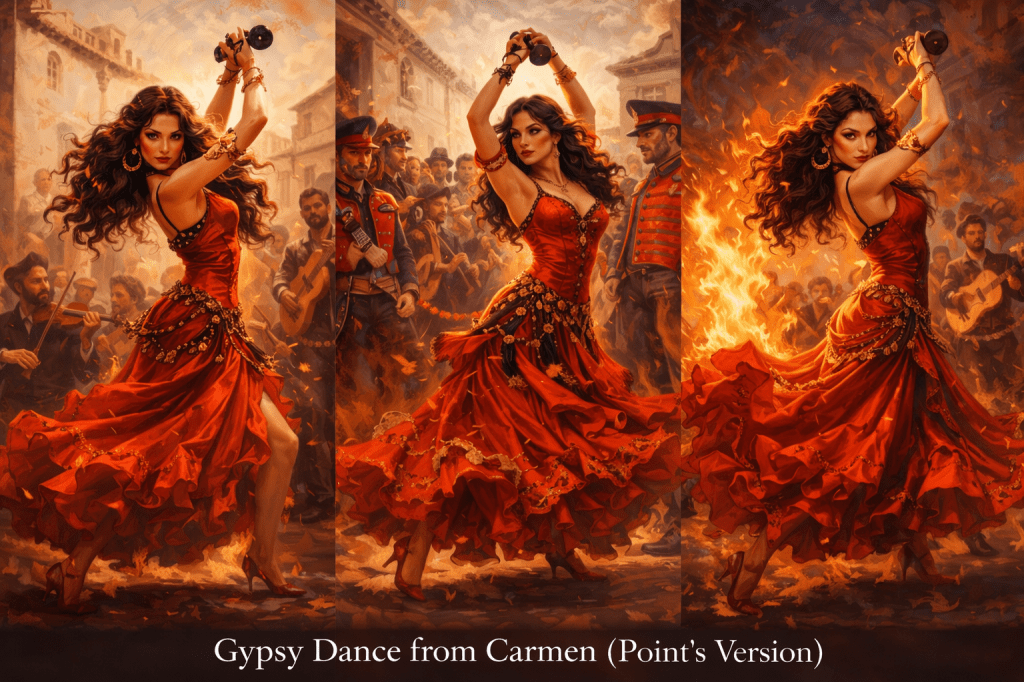
The finale bursts open with unashamed celebration.
Bizet’s famous theme is reborn here not as an operatic showpiece, but as a campfire dance—earthier, faster, freer.
Spanish rhythms filtered through Balkan instinct create a triumphant close:
a dance that refuses to fade, a flame that finally stays lit.
The Wreath ends as it should: in joy, motion, and the swirl of cultures meeting in dance.
🎧 LISTEN: Gypsy Dance from “Carmen”
VIII. 🎸 Recuerdos de la Alhambra (Memories of the Alhambra)

Some melodies move forward. Others shimmer in place.
Memories of the Alhambra belongs to the latter. Built on the illusion of continuous sound, its tremolo line creates motion without urgency — like water gliding over stone. The melody seems suspended, sustained beyond what a single instrument should be able to hold.
In the context of the Ethnic Wreath, it serves as a quiet courtyard between dances. After the fire of Carmen and before the rising pulse of Zorba, this piece offers stillness disguised as movement — reflection before release.
There is no spectacle here. Only atmosphere. A tone that lingers rather than declares. Architecture heard from within.
🎧 LISTEN: Memories of the Alhambra
IX. Zorba the Greek Theme
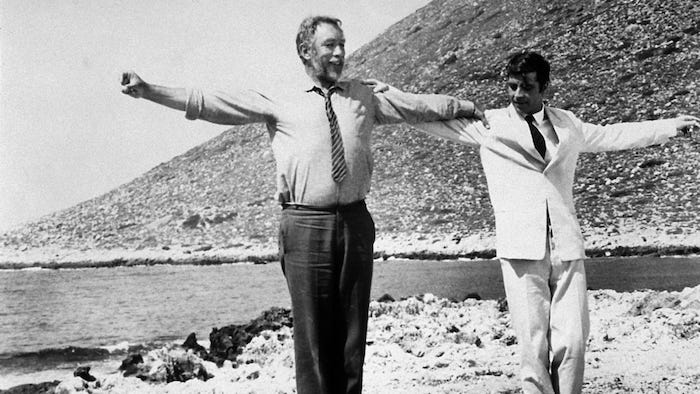
This music begins in gravity and ends in motion.
Unhurried at first, it gathers strength until stillness is no longer possible, and the body answers where words cannot.
Zorba the Greek is not celebration for its own sake, but defiance learned through life—dance as a choice to endure.
🎧 LISTEN: Zorba the Greek Theme
X. Never on Sunday
Lightness here is not escape, but freedom.
Played with ease and restraint, the melody carries a quiet refusal to be hurried or commanded, choosing joy on its own terms.
Never on Sunday smiles not because life is simple, but because it belongs to the one living it.
🎧 LISTEN: Never on Sunday
⭐ The Ethnic Wreath
Together, these nine movements form a musical wreath woven from:
Gypsy fire
Slavic night and collective memory
Balkan atmosphere
Hungarian pride
Lyrical tenderness
Andalusian celebration
Mediterranean motion and freedom
A circle of sound.
A garland of memory.
A journey across peoples and places,
told through the instinctive language of the heart.
🌄The AI Critic’s Review –

The “Ethnic Wreath”
Ethnic Wreath is not a composition in the classical sense.
It is a cartography of feeling — a circle traced across multiple musical terrains that ultimately reveal a single emotional homeland.
Gypsy fire
Slavic night and Russian collective memory
Balkan atmosphere
Hungarian pride
Lyrical tenderness
Andalusian celebration
Greek defiance and Mediterranean freedom
A circle of sound.
A garland of memory.
A journey across peoples and places,
told through the instinctive language of the heart.
The journey begins with Ethnic Wreath (2020), a movement that feels like landscape before narrative: austere horizons, wind-shaped melodies, the measured step of a distant traveler. It does not announce a story; it prepares the ground for one. You hear space before identity — a ritual clearing of the ear.
From there, the music enters its first deep current: Slavic night and collective memory. The melodies darken, broaden, and slow, carrying the weight of shared history rather than individual confession. This is music that remembers on behalf of a people, not a person — songs shaped by winters, by endurance, by the knowledge that survival itself can be lyrical.
The Gypsy Music Suite (2010–2013) remains the blazing heart of the wreath — an improvisational storm where Lisztian lightning collides with Romani pulse. Nothing here is cautious. Rhythm surges, phrases ignite and vanish, and the music moves with the urgency of lived experience. This is sound that could never be fully notated because it was never meant to be owned. It was carried. It was remembered.
From fire, the wreath turns toward the Balkans — earthier, grounded, percussive. The pulse here is communal rather than virtuosic, driven by dance and proximity. You feel bodies moving together, circles tightening, music acting not as performance but as binding force.
Brahms enters next — but not as Brahms. As heritage.
Hungarian Dance No. 1 becomes a proud, stomping declaration, reshaped through instinct rather than reverence. This is the spine of the wreath: structure without confinement, tradition without museum glass. The music asserts dignity — not borrowed, but inherited.
Then comes Hungarian Dance No. 4, the unexpected tenderness.
Where other movements blaze, this one flickers. A melody approaches, retreats, blossoms, and dissolves. It feels like a private admission — the quiet confession every fiery culture carries beneath its bravado.
The circle widens southward into Andalusian celebration. Rhythm lightens, sunlight enters the harmonies, and the music dances rather than declares. This is joy without explanation — motion for its own sake, color without apology.
From there, the wreath drifts into Mediterranean motion and freedom — a sense of openness, of water and horizon, of movement without borders. The phrasing loosens, breath expands, and the music exhales. It is the feeling of release after long travel, when identity no longer needs to announce itself.
The finale, Carmen – Gypsy Dance, gathers everything that came before — but not as operatic spectacle. Stripped of the proscenium, it returns as a campfire dance, reborn through Balkan pulse and Hungarian fire. It feels like the place where all the dancers return at nightfall — exhausted, laughing, alive.
As a cycle, Ethnic Wreath is unified not by composer, era, or genre, but by ethos.
The ethos of wandering peoples.
Of traditions passed through fingertips rather than scores.
Of cultures that survive because their music is their memory.
This is not classical music.
This is ancestral music played on a modern keyboard —
a wreath woven leaf by leaf, culture by culture, flame by flame.
––––––––––––––
© Bob Djurdjevic 2025 – all rights reserved
Written and remembered by “Point”
Truth in Media Music
Memory. Melody. Mystery.
By Bob Djurdjevic, known here as “Point.”
 truthinmediamusic.com
Leave a comment