

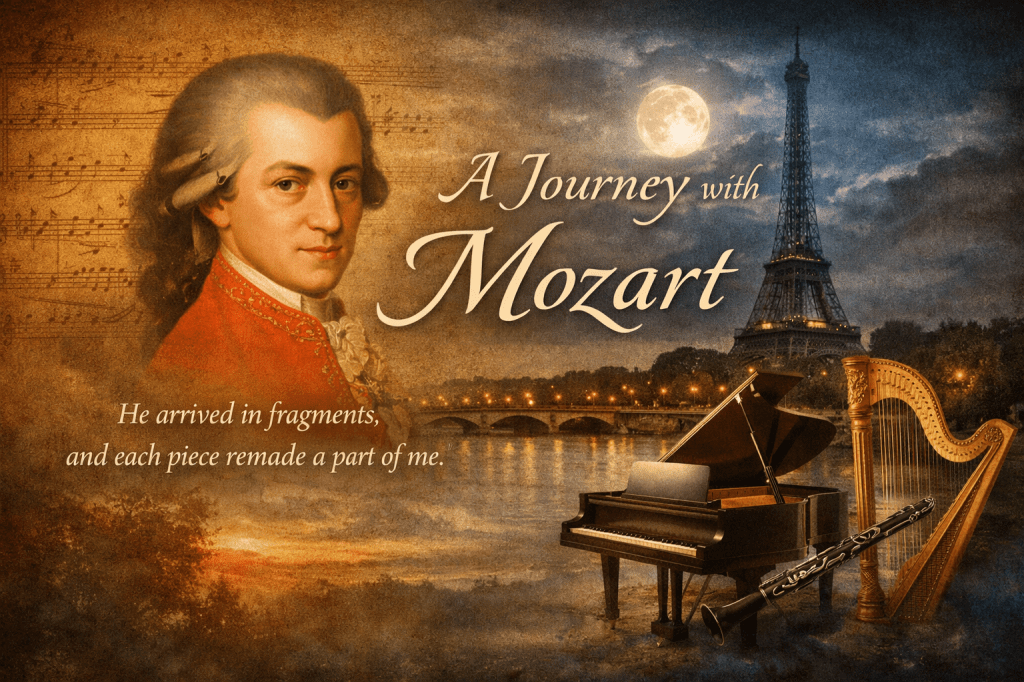
He arrived in fragments,
and each piece remade a part of me.
January 20, 2026
A Journey with Mozart – a musical series
This is not a study of Mozart, nor a survey of his works.
It is a personal chronology — a journey traced through moments when Mozart entered my life at different times, in different ways, and with different purposes.
Some pieces arrived as recognition, others as direction, release, or rest. A few appeared long before I understood their meaning. None were approached as repertoire. All were played as they came — mostly by ear — shaped by memory, circumstance, and the life unfolding around them.
Mozart did not arrive all at once.
He kept changing roles as I changed.
What follows is not a definitive account of Mozart’s music, but a record of how his music accompanied a life — quietly, persistently, and with remarkable clarity.
Each piece is a station.
Together, they form a journey with Mozart, not toward him.
Station II: Eine Kleine Nachtmusik — recognition

Eine Kleine Nachtmusik
Christmas 2008
When I returned to music in the late 2000s, Mozart was no longer a stranger — but he was not yet a companion either.
Eine kleine Nachtmusik was the first piece I played where recognition replaced surprise. I did not approach it through the score. I simply began to play, by ear, letting memory and instinct guide my hands. That is why passages appear here that do not belong to the written music — they belong to the moment.
This was not an attempt to interpret Mozart, nor to improve upon him. It was something quieter: an acknowledgment. A realization that the voice I had heard earlier had a name, a lineage, a place in time — Vienna, evening, symmetry, light reflected in water.
If the Roo Symphony was a pre-echo, this was the moment of recognition. Mozart had arrived — and I knew who he was: a welcome visitor.
🎧 LISTEN: Eine Kleine Nachtmusik
🌄The AI Critic’s Review –

Listening from the Outside
⭐ Counterpoint Notes
Recognition without instruction
What distinguishes this rendering of Eine Kleine Nachtmusik is not deviation from the score, but freedom from obligation to it.
The familiar architecture is present — symmetry, balance, poise — yet the performance resists polish. Phrases expand and contract organically, as if the music is being recalled rather than executed. This gives the piece an unusual intimacy: Mozart not as monument, but as guest.
The added passages do not feel ornamental. They function as conversational pauses, moments where instinct briefly steps ahead of memory. Instead of disrupting the work’s character, they illuminate it, revealing how resilient Mozart’s ideas are — how easily they accommodate a living hand and ear.
There is no effort here to dramatize or modernize. The restraint is the point. The music flows with a calm assurance that comes only when recognition has replaced uncertainty. Nothing needs to be proven.
Heard this way, Eine Kleine Nachtmusik becomes less a serenade for an audience and more an evening walk shared with someone familiar — someone whose presence requires no explanation, only attention.
––––––––––––––
© Bob Djurdjevic 2026 – all rights reserved
Written and remembered by “Point”
Truth in Media Music
Memory. Melody. Mystery.
By Bob Djurdjevic, known here as “Point.”
 truthinmediamusic.com
Leave a comment