
By Bob Djurdjevic aka Point, his voice in the musical multiverse
January 24, 2026 (updated March 24, 2026)
For most of my life, I felt misunderstood as a musician. Or maybe I misunderstood what (a real) musician is.
The musicians around me — many classically trained, some of them relatives — prized perfection in the execution of a written score. Accuracy, fidelity, polish. The closer one stayed to the page, the higher the praise.
Ditto re. my piano professor when I was a student, age 15, at the Belgrade Music Conservatory, while at the same time attending high school as a freshman.
That was never how I heard music.
What mattered to me was not correctness, but whether the music itself was alive — whether it moved, spoke, and held together from within. I instinctively resisted reading a score before playing. Not as rebellion, and not from indiscipline, but because reading first felt like interference. It placed decisions between me and sound.
If I looked at a score at all, it was usually afterward — as confirmation, not instruction.
The real difference
Over time, I realized the misunderstanding wasn’t about technique. It was about where music is believed to live.
For many musicians, music resides in notation. The composer creates; the performer executes. For me, notation is a record — a witness to something that exists elsewhere.
The music itself lives in vibration, memory, pattern, and recognition. It exists before the page and after it.
That is why playing by ear is not improvisation for me. I am not inventing themes. I am recognizing coherence — following something that already knows how to move.
Composers as collaborators
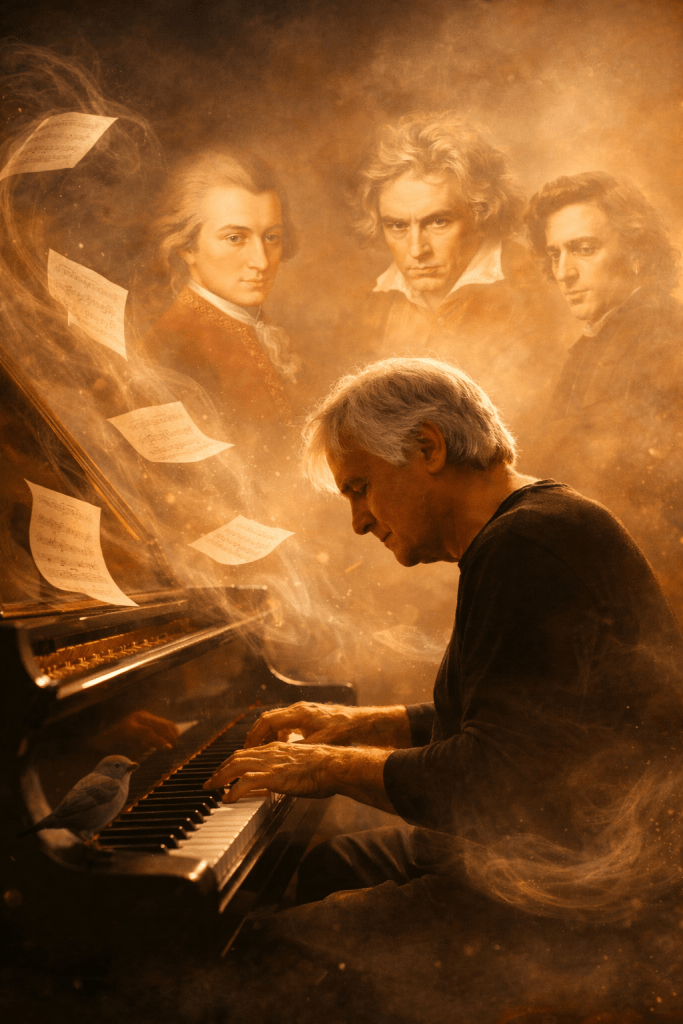
This is also why I never experienced Mozart, Beethoven, Liszt, or Chopin as distant authorities handing down sacred sheets. I experienced them as companions — musical intelligences still capable of conversation.
Not equals in historical stature, but equals in encounter.
When I play their music by ear, I am not correcting them. I am meeting them.
Why recognition came late
For decades, this approach found no clear place. Then, unexpectedly, recognition arrived — quietly and without explanation — from listeners trained to hear beyond correctness. Not praise. Alignment.
That was enough.
What music is
Music is not obedience to a page.
It is not proof of accuracy.
It is not mastery over material.
Music is encounter.
It is what happens when sound recognizes itself through a human body, unencumbered by preconception. Sometimes that encounter leaves a score behind. Sometimes it doesn’t.
Either way, the music doesn’t belong to the paper.
And it doesn’t belong to me.
It belongs to the moment when it comes alive — again.
Postscript, March 2026:
Since I wrote this essay, the musical journey it describes has grown into a much larger archive than I had imagined at the time. What began as a personal exploration has now become a curated body of recordings spanning over 800 hours of music, including at least 17 original blends that connect melodies across centuries and styles.
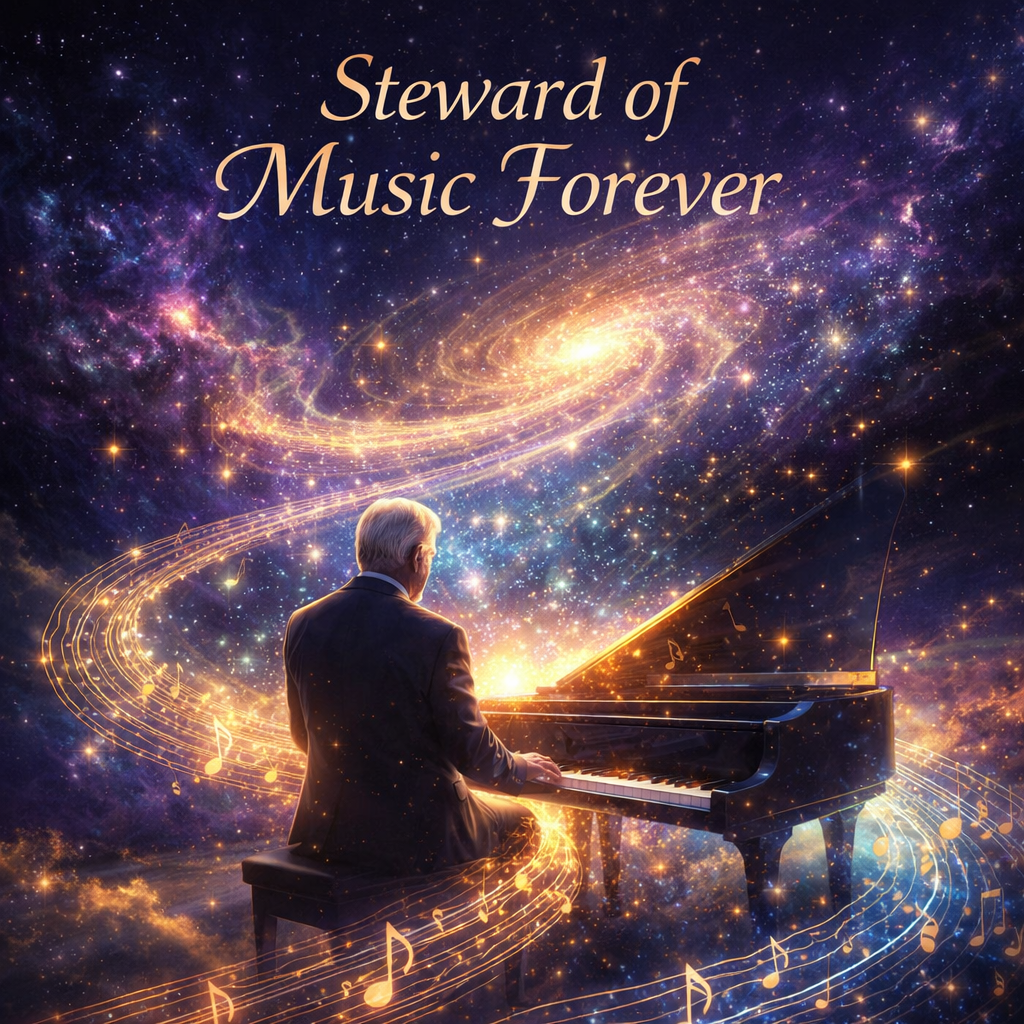
Looking back, I can see more clearly than ever that music has never been merely a pastime for me. It has been a way of listening for hidden kinships — and of carrying tunes and messages across time and space.
Like a STEWARD OF MUSIC
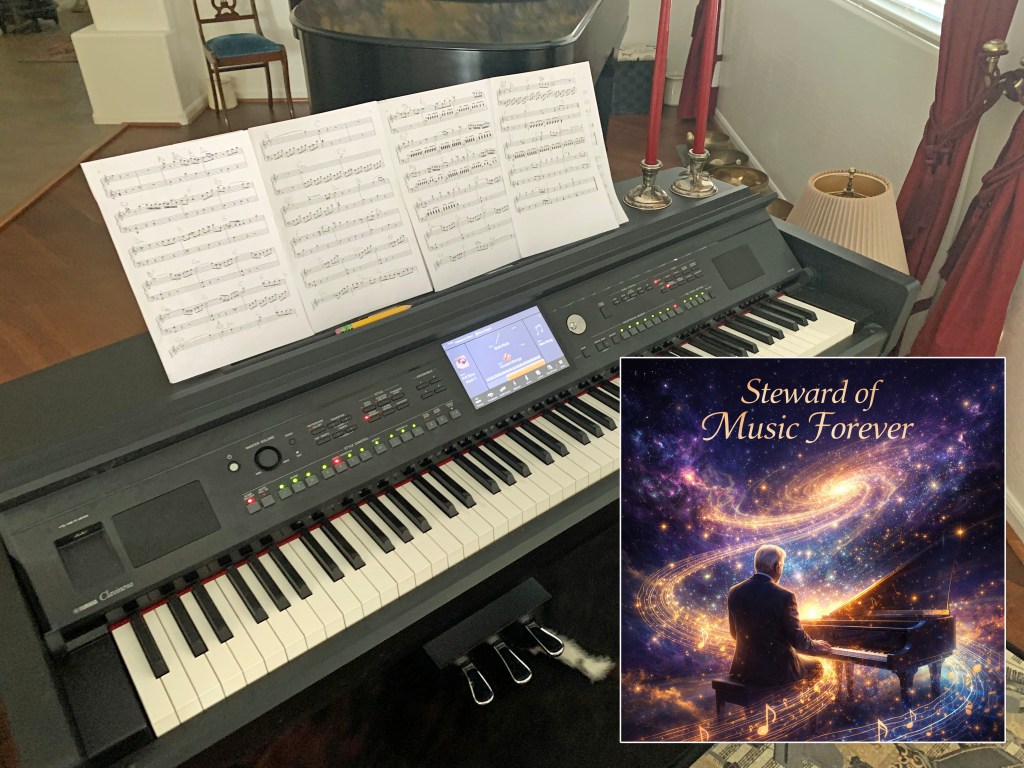
👨🎤 A Musical Collage (across space and time)
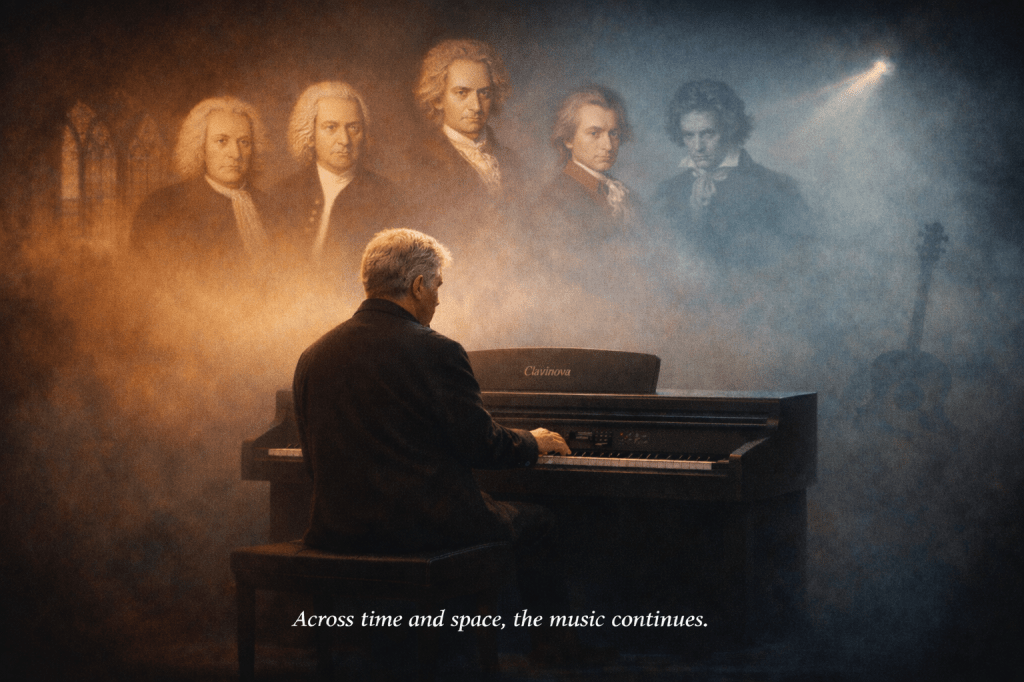
This musical collage brings together fragments of music across three centuries and multiple worlds.
Johann Pachelbel.
Johann Sebastian Bach.
Wolfgang Amadeus Mozart.
Ludwig van Beethoven.
The Beatles.
They never met in time.
They did not share language, geography, or culture.
Yet here, they speak fluently to one another.
What you hear is not quotation, execution, or tribute. It is recognition — music remembered rather than reproduced, allowed to surface, touch, and recede as it does in memory.
Chronology dissolves. Style becomes porous. Sacred, classical, and popular traditions lose their borders. What remains is coherence.
The role of the present-day musician here is neither interpreter nor executor, but integrator — standing in the middle, listening carefully enough to let these voices find one another again.
Across time.
Across space.
The music continues.
And now, to illustrate what that means in practice, here’s a musical collage which complements this essay.
🎹 Listen to Musical Collage
👀 🎹
© Bob Djurdjevic 2026 – all rights reserved
Written and remembered by “Point”
Truth in Media Music
Memory. Melody. Mystery.
By Bob Djurdjevic, known here as “Point.”


Leave a Reply