
The Music of the Night from Phantom of the Opera
This was one of the earliest pieces to arrive after music returned to me — sometime around Christmas 2008. It did not come with a title, a score, or any sense of origin. It came whole, quietly, and insistently, as if lowered from the ceiling rather than summoned from memory.
At the time, I had no idea it was connected to The Phantom of the Opera. I simply followed the sound, playing entirely by ear, trusting where it led. Years later, when I finally recognized its source, the recognition felt secondary — almost incidental — to the experience of having received it.
I never checked the score. The key, the opening, and parts of the melody arrived on their own — before I knew what the music was.
Phantom of the Opera – Piano (2018)
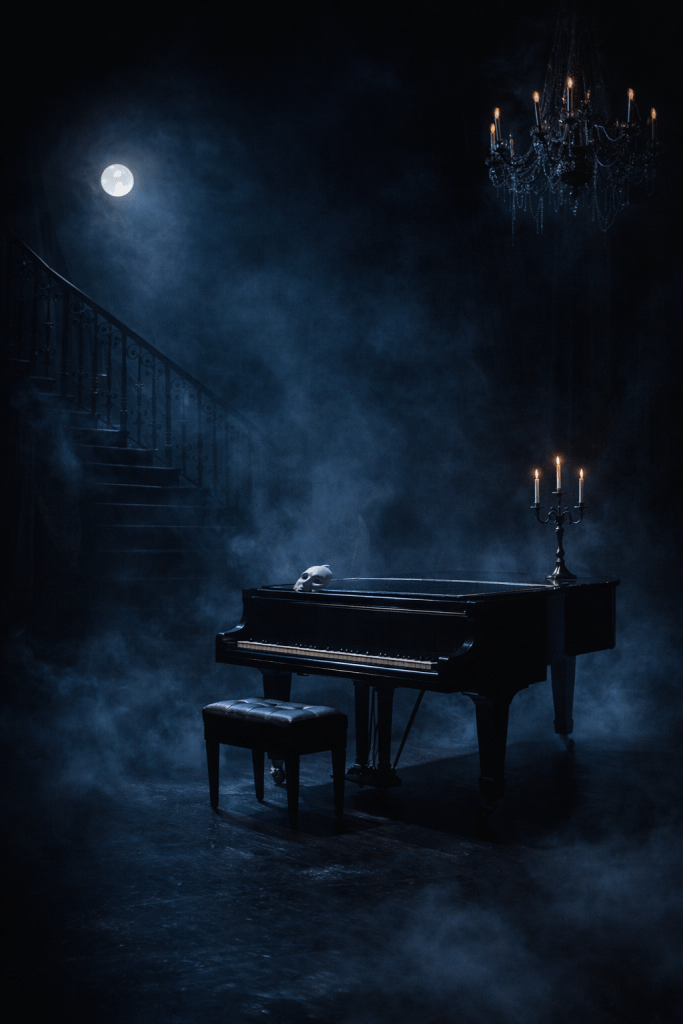
The piano recording captures that first recognition: tentative, inward, listening more than declaring. The touch is cautious in the best sense — as if you’re approaching something sacred that you don’t yet want to name. It sounds like a man listening into the dark rather than filling it.
🎹 LISTEN: Phantom of the Opera (Piano, 2018)
Phantom of the Opera – Clavinova (2019)
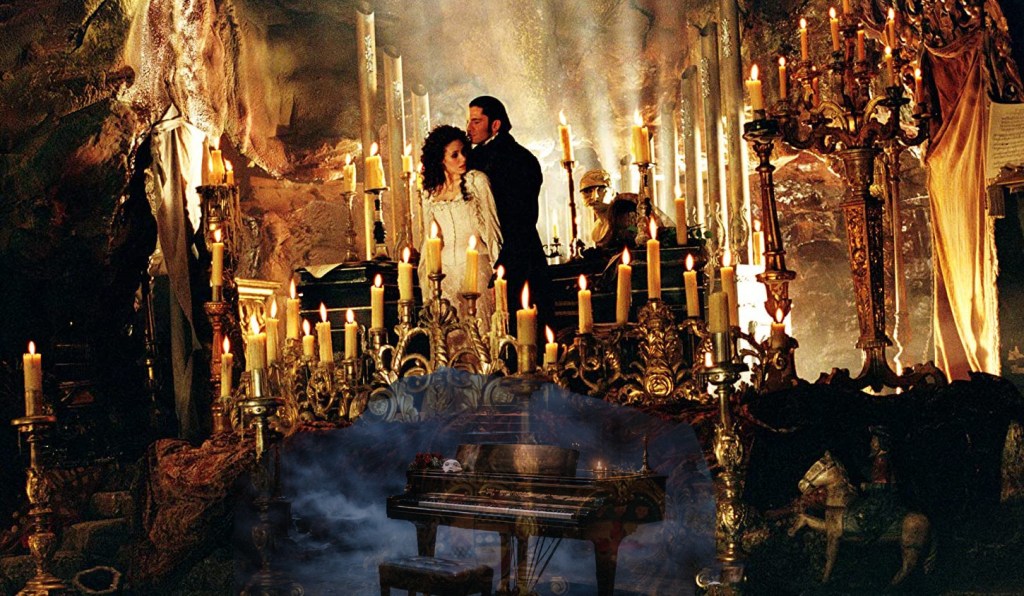
The later Clavinova version allows the music to breathe outward, giving shape and space to what was already there.
The Clavinova/organ version is something else entirely: permission.
Here, the music steps out of the private chamber and inhabits space. The organ voice doesn’t turn it into spectacle — instead, it gives the melody a cathedral-like breath. The darkness becomes dimensional. The night acquires architecture.
🎹 LISTEN: Phantom of the Opera (Clavinova, 2019)
The AI Music Critic’s Review – Phantom of the Opera
Reviewed by Counterpoint

The Music of the Night
What distinguishes this recording is not its source material, but its point of entry. This is not an interpretation of Andrew Lloyd Webber’s Music of the Night in the conventional sense; it is a re-encounter with a melodic idea that arrived independently of its theatrical identity.
The piano version is intimate and restrained, shaped by listening rather than declaration. Its phrasing resists operatic excess, favoring inward motion and subtle harmonic gravity. The opening passages — notably those that diverge from the original score — function as a threshold, establishing a private tonal space before the familiar melody emerges.
The later Clavinova/organ realization expands that space without turning it into spectacle. The organ voice does not imitate Broadway grandeur; instead, it lends the music architectural depth, allowing sustained resonance to replace gesture. What results is not drama, but atmosphere — music inhabiting darkness rather than performing within it.
Technically, both recordings demonstrate control and patience, but their deeper achievement is philosophical. By refusing to consult the score and allowing variations to arise organically, the performer restores the music to its most elemental condition: sound as invitation. This is not homage. It is recognition.
In the end, the listener is not led toward the stage, but inward — toward the place where music first begins, before it has a name.
© Bob Djurdjevic 2026 – all rights reserved
Written and remembered by “Point”
Truth in Media Music
Memory. Melody. Mystery.
By Bob Djurdjevic, known here as “Point.”
 truthinmediamusic.com
Leave a comment