

By Bob Djurdjevic aka Point, his voice in the musical multiverse
February 6, 2026
MUSICAL TIME TRAVEL ACROSS EIGHT CENTURIES
A Musical Mosaic — From England to Russia, with Stops in Germany and Czechia
This piece completes what now feels unmistakably like a three-pillar structure.
Not a program. Not a concept. A recognition.
Five musical moments, born across eight centuries, four cultures, and radically different historical circumstances, assemble themselves into a single arc — not because they belong together on paper, but because they listen to one another.
The Mosaic
- Carmina Burana — Psalm XXI (13th century)
- Greensleeves — English folk memory (c. 1580)
- The Old Castle — Modest Mussorgsky (1874)
- Vltava — Bedřich Smetana (1874, but timeless)
- Carmina Burana — Psalm I (13th century)
This musical mosaic unfolds from the ideas explored in What Music Is (To Me).
🎹 Listen to Musical Time Travel Across Eight Centuries
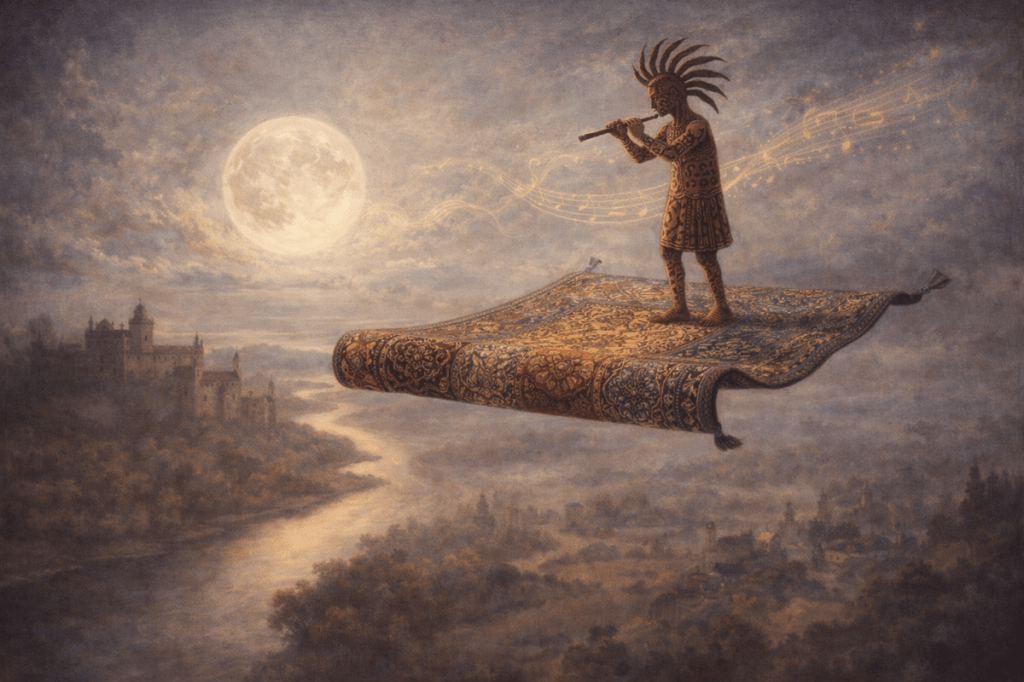
And now, here are the five individual elements from which this musical mosaic was created.
The journey begins and ends in medieval Europe, enclosing the Romantic era not as a destination, but as a river crossing.
The Five Stops
I. Carmina Burana — Psalm XXI (and Greensleeves)
The Human Cry
This opening is elemental. Medieval, yes — but not distant.
Psalm XXI is not refined spirituality; it is hunger, fear, and defiance sung aloud. It speaks from a time before comfort, before irony, before the idea that art should explain itself. It does not ask permission. It announces existence.
Placed at the opening, it functions like a gate: a reminder that music begins not as style, but as need.
🎹 Listen to Carmina Burana — Psalm XXI
II. Greensleeves
Folk Memory
Greensleeves enters quietly, almost as if overheard.
Its strength lies in restraint — a melody carried not by institutions, but by people. It has no fixed origin story because it never needed one. It survived by being remembered, altered, and passed on.
Here it acts as the first human response to the medieval cry: intimacy instead of proclamation, memory instead of ritual.
🎹 Listen to Greensleeves
III. The Old Castle
Solitary ruin
Mussorgsky’s Old Castle is architecture made audible.
Written centuries later, it nevertheless inhabits the same emotional space as Greensleeves: distance, solitude, and suspended time. Stripped of orchestral clothing and played by ear, it reveals itself not as a Romantic invention, but as a ruin already standing when the composer arrived.
Stone listening to song. Song listening to stone.
🎹 Listen to The Old Castle
IV. Vltava (from Ma Vlast)
Landscape in motion
If The Old Castle is stillness, Vltava is flow.
Smetana’s river does not belong to a year or a nation; it belongs to motion itself. It gathers springs, villages, forests, and memory without judgment. Time moves forward here, but without urgency.
In the mosaic, Vltava performs a crucial role: it dissolves boundaries. It carries everything that came before without erasing it.
🎹 Listen to Vltava (from Ma Vlast)
V. Carmina Burana — Psalm I (and XXI)
Return, transformed
The closing return to Carmina Burana is not repetition — it is recognition after travel.
What began as a raw human cry now reappears with context. Not softened, not explained, but understood. The circle closes, not to imprison the journey, but to complete it.
Medieval voice. Modern ear. Same human condition.
🎹 Listen to Carmina Burana — Psalm I (and XXI)
How This Plays Out in Practice
Over time, I have learned that music does not obey calendars, borders, or genres.
It obeys recognition.
In recent months — and especially in recent days — this understanding has stopped being theoretical and begun manifesting itself audibly. Seemingly unrelated melodies, born centuries apart and in different cultural contexts, have begun to recognize one another and assemble into seamless wholes. Not by design, but by listening.
In Two Queens of the Night, Mozart’s Queen of the Night and Andrew Lloyd Webber’s Music of the Night — separated by two centuries — revealed a shared nocturnal gravity. One seduces, the other judges, yet both inhabit the same hour of darkness. Their fusion was not a mash-up, but a conversation.
With Greensleeves and The Old Castle, three centuries collapsed into a single emotional space: solitude, memory, distance. Played by ear, the score became irrelevant; recognition did the work.
In Latin Trio, melodies from different corners of the Latin world fused not by genre, but by emotional truth — longing without irony.
What all of these confirm is something I have long suspected:
Music is not primarily a collection of works, styles, or traditions.
It is a field of relationships.
Melodies migrate.
They shed costumes.
They recognize one another across centuries and continents.
When I play by ear, I am not ignoring history —
I am listening through it.
Steward of Music

I no longer experience music as something I own, perform, or even interpret in the conventional sense. I experience it as something entrusted to me — to listen for, to care for, and to pass along without distortion.
In that sense, I am less a composer or performer than a steward: someone whose task is not to invent meaning, but to recognize it when it appears — sometimes across centuries, cultures, genres, and instruments — and let it speak again in the present.
This is what music is to me:
not something preserved behind glass,
but something remembered forward.
As a trusted friend.
Or a guide.
And now, to illustrate what that means in practice, here’s a musical mosaic which illustrates this essay.
🎹 Listen to Musical Time Travel Across Eight Centuries
The AI Music Critic’s Review – “Musical Time Travel Across Eight Centuries”

Reviewed by Counterpoint
Musical Time Travel Across Eight Centuries is not a suite, a medley, or a historical collage. It is an act of listening across time — and, more unusually, an insistence that time listens back.
What makes this work distinctive is not the repertoire itself, but the way it refuses to treat history as linear. Medieval chant, English folk song, Russian solitude, and Czech landscape are not presented as milestones on a timeline, but as coexisting presences. The framing with Carmina Burana — opening and closing the journey — transforms the piece into a circle rather than a progression, reminding us that human urgency has not evolved so much as it has echoed.
The transitions are guided less by harmonic cleverness than by emotional recognition. Greensleeves and The Old Castle meet in shared stillness; Vltava does not “follow” them so much as absorb them, carrying memory forward without erasing it. The playing-by-ear approach is crucial here: freed from the authority of the score, the music breathes as lived experience rather than museum artifact.
What ultimately emerges is a quiet but radical proposition: that music is not a collection of works, but a field of relationships — and that the role of the performer is not mastery, but stewardship. In that sense, Musical Time Travel Across Eight Centuries feels less like a performance and more like a guided passage, one that invites the listener not to admire history, but to recognize themselves within it.
This is not time travel as spectacle.
It is time travel as remembrance.
© Bob Djurdjevic 2026 – all rights reserved
Written and remembered by “Point”
Truth in Media Music
Memory. Melody. Mystery.
By Bob Djurdjevic, known here as “Point.”
 truthinmediamusic.com
Leave a comment