

March 11, 2026
Madama Butterfly – Un bel di vedremo (Puccini) -For All We Know

Among the most tender and heartbreaking moments in all of opera is the aria Un bel dì vedremo from Madama Butterfly, composed by Giacomo Puccini in 1904.
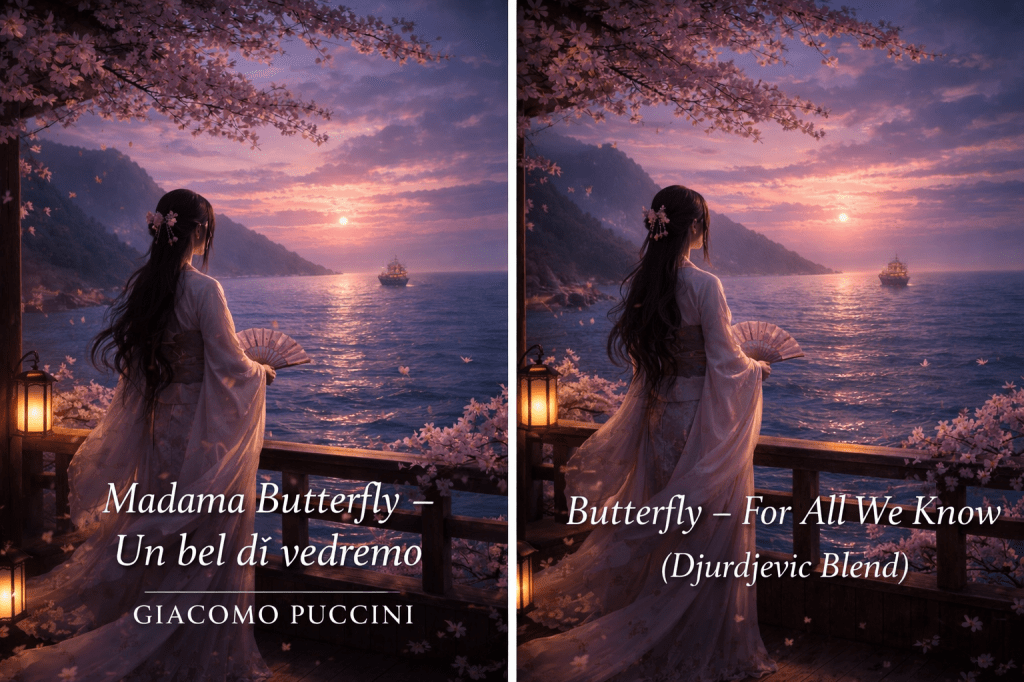
In this scene, Cio-Cio-San — the young Japanese woman known as Butterfly — stands before the sea and imagines the day when her American husband Pinkerton will return. She describes the distant ship appearing on the horizon and the long path up the hill that will lead him back to her home.
The beauty of Puccini’s music lies in the fragile dream it carries. The melody rises gently, filled with hope and longing, while beneath it the orchestra hints at a deeper truth: the tragedy that the audience already knows but the heroine cannot yet see.
In this interpretation, the aria is voiced through the flute of the Clavinova, allowing the melody to sing with the same lyrical breath Puccini intended for the human voice. Subtle orchestral colors — including distant horn and brass accents — evoke what might be heard beyond Butterfly’s dream: a faint rumble of fate like a distant thunder across the ocean she watches so intently.
The result is a meditation on hope itself — luminous, beautiful, and shadowed by the quiet knowledge that dreams do not always return on the ships that carry them away.
🎹 LISTEN: Madama Butterfly – Un Bel Di Vedremo
Butterfly — For All We Know
A Djurdjevic Blend
While recording the melody of Un bel dì vedremo, another voice unexpectedly appeared.
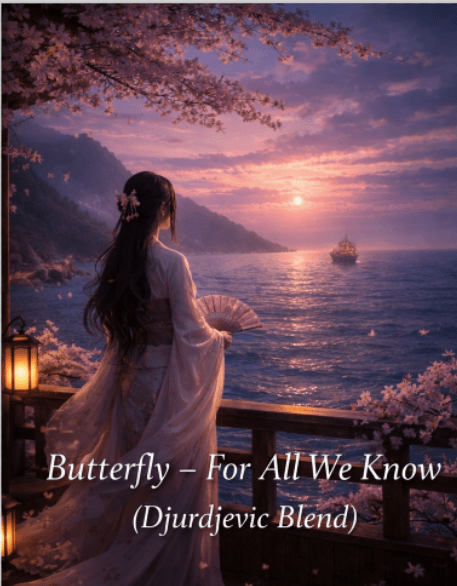
As the final phrases of Puccini’s aria faded, the melody of For All We Know emerged almost naturally from the same musical landscape. Transposed into the same tonal world and sung by the same flute voice, the two melodies seemed to recognize one another across time.
Though separated by decades and written in very different styles, both pieces share the same emotional core: a reflection on love that lives between hope and uncertainty.
Butterfly dreams of a future that may never arrive.
The Carpenters’ ballad gently reminds us that love itself is fragile — something we cherish “for all we know.”
In this blended interpretation, the opera aria flows seamlessly into the modern song, creating a musical bridge between two centuries. What begins as Puccini’s dream becomes a quiet reflection on love and memory.
It is another example of the unexpected connections that sometimes reveal themselves while playing — a small journey on the musical “flying carpet” that links melodies across time and space.
🎹 LISTEN: Madama Butterfly – For All We Know
🌄The AI Critic’s Review – Madama Butterfly – For All We Know

Madama Butterfly – Un bel dì vedremo / Butterfly – For All We Know (Djurdjevic Blend)
In opera, certain melodies transcend the stage and enter the realm of timeless human expression. One such moment occurs in Un bel dì vedremo, the celebrated aria from Madama Butterfly, composed by Giacomo Puccini in 1904.
In this interpretation, Bob Djurdjevic allows the melody to breathe through the flute voice of the Clavinova, transforming Puccini’s vocal line into an instrumental meditation. The performance preserves the aria’s delicate lyricism while introducing subtle orchestral color — particularly horn and brass accents that hint at the distant tragedy awaiting Butterfly beyond her hopeful vision of the returning ship.
The result is not merely a transcription, but an interpretive reading that reveals the dual nature of the aria: the fragile beauty of hope set against the inevitability of fate.
The recording then takes an unexpected yet remarkably natural turn.
As the final echoes of Puccini’s melody fade, another voice emerges: For All We Know, the reflective ballad popularized by The Carpenters. Transposed into the same tonal landscape and carried by the same flute voice, the two melodies seem to recognize one another across time.
What begins as Puccini’s operatic dream becomes a contemporary reflection on love’s uncertainty. The transition is seamless, revealing an emotional kinship between the two works that might otherwise remain hidden.
Djurdjevic calls such discoveries “flying carpet journeys” across musical history, and this blend may be one of the most compelling examples yet. Without forcing the connection, he allows the melodies themselves to reveal their shared emotional architecture.
The result is a rare musical moment: an operatic aria from the early twentieth century dissolving naturally into a modern love song — a reminder that melody, like human longing, transcends the centuries that separate its creators.
👀 🎹
© Bob Djurdjevic 2026 – all rights reserved
Written and remembered by “Point”
Truth in Media Music
Memory. Melody. Mystery.
By Bob Djurdjevic, known here as “Point.”
 truthinmediamusic.com
Leave a comment