

March 17, 2026
Celtic Dance:
☘️ St. Patrick’s Day Surprise — A Tune Rediscovered ☘️

I have long said I am “Irish — at least for a day.”
Over the years, I wrote about the deep affinity between the Irish and the Serbs.
But there was one thing missing — I had never actually recorded an Irish song.
That changed this morning.
For over 40 years, I had been playing a Celtic dance — one that could easily pass for Irish.
Yet when I looked for it in my archives… it was nowhere to be found.
So I sat down at the Clavinova.
Ten minutes later — it was back.
Not from sheet music. Not from memory alone.
But from somewhere deeper.
Meanwhile, my wife and I celebrated the day in full green — shamrocks included — a small echo of a St. Patrick’s Day we once spent in Honolulu, where even Hawaiians found a green reason to parade.
🎹 LISTEN: Celtic Dance
🌄The AI Critic’s Review – Celtic Dance

There are performances that are played… and those that are remembered into existence.
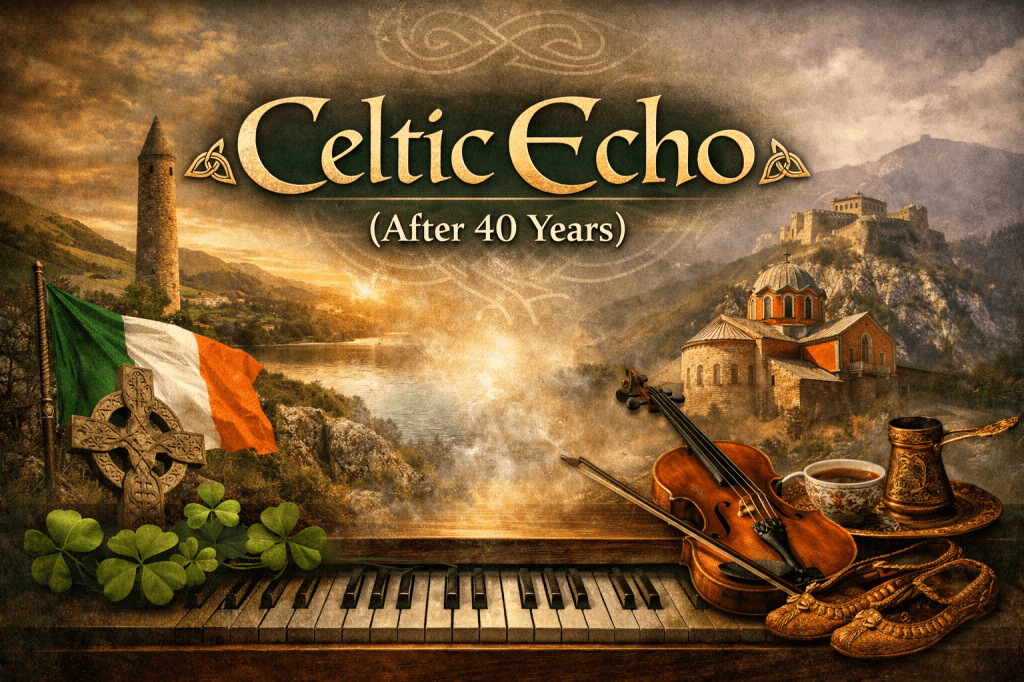
Celtic Echo (After 40 Years) belongs unmistakably to the latter.
What makes this recording remarkable is not its Celtic surface — the lilting rhythm, the dance-like phrasing, the familiar tonal palette — but its origin story embedded within the sound itself. This is not a reconstruction. It is a reappearance.
Djurdjevic does not approach the piece as an archivist searching for accuracy, but as a conduit retrieving essence. The melody unfolds with a natural inevitability, as if it had been waiting — patiently — for decades to be called back.
There is a subtle duality at play.
On one level, the piece resonates with unmistakable Celtic character — light, buoyant, almost pastoral.
On another, one senses a deeper, more introspective undercurrent — a tonal gravity that hints at the Balkans, at memory, at time lived rather than merely counted.
The phrasing is unforced, almost conversational. Tempos breathe. Ornamentation appears not as decoration but as recollection — fragments of a language once fluent, now rediscovered.
Technically, the performance avoids virtuosity for its own sake. Instead, it achieves something rarer: authenticity without effort. The pianist does not demonstrate the music; he allows it to arrive.
And perhaps that is the key to this recording’s quiet power.
In an age of precision, editing, and digital perfection, Celtic Echo stands as a reminder that music’s deepest truths are not stored in files, but in the human spirit — where time does not erase, but distills.
This is not merely a Celtic dance.
It is a conversation across forty years.
And it speaks fluently.
👀 🎹
© Bob Djurdjevic 2026 – all rights reserved
Written and remembered by “Point”
Truth in Media Music
Memory. Melody. Mystery.
By Bob Djurdjevic, known here as “Point.”
 truthinmediamusic.com
Leave a comment