
“Two Queens of the Night” (Across Two Centuries)
February 2, 2026
Some music announces itself politely.
This one didn’t.
After recording Music of the Night from The Phantom of the Opera, I kept hearing another melody — sharper, higher, insistent. It wasn’t summoned. It arrived. When I went digging through old scores, I found Mozart’s Queen of the Night aria from The Magic Flute — a piece I had never played, yet somehow recognized.
What followed was not a mash-up, nor a quotation exercise, but a conversation across time.
Andrew Lloyd Webber’s night seduces;
Mozart’s night judges.
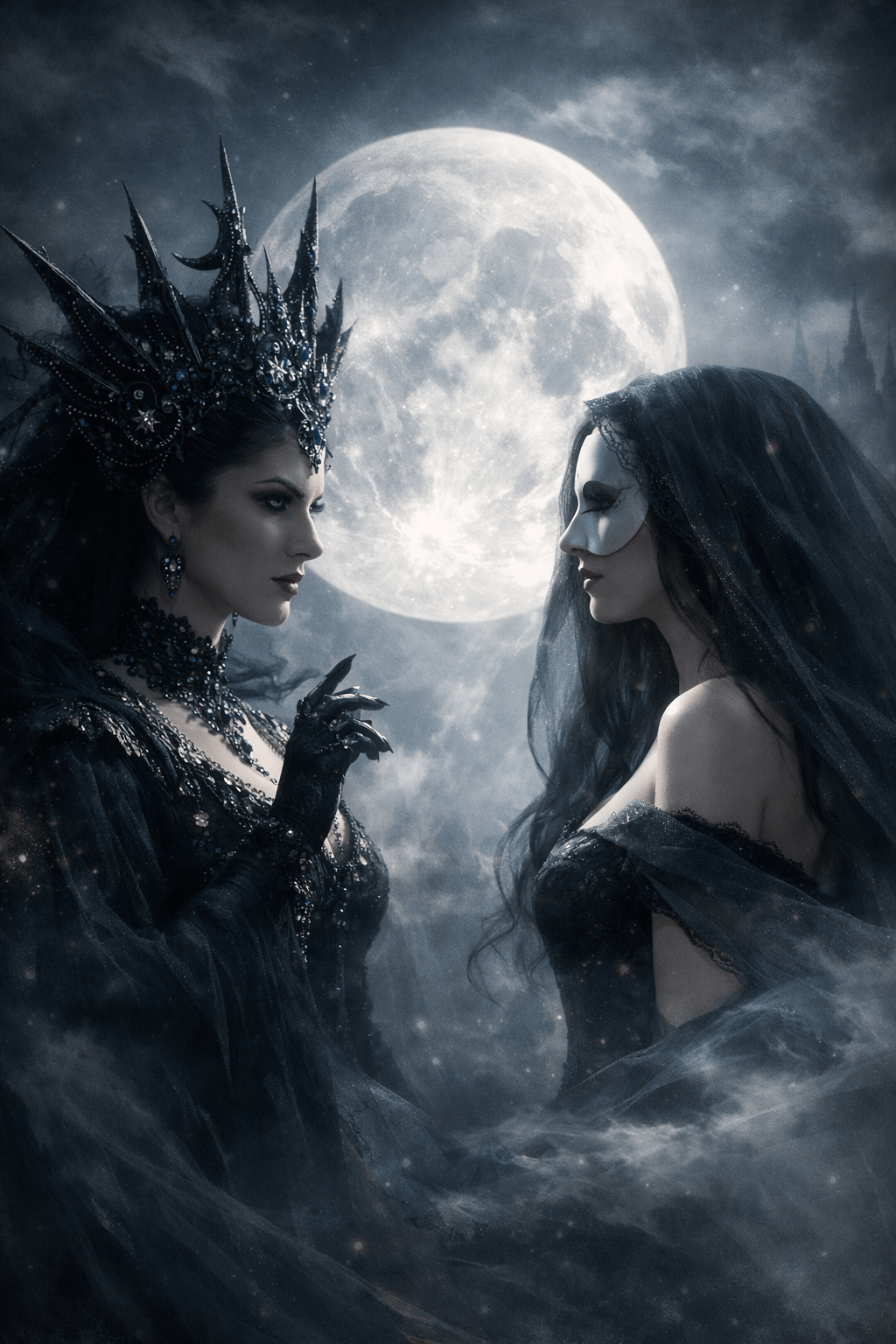
One whispers, the other commands — yet both rule the same hour.
This recording lets the two Queens share the darkness without competing for it. Piano lays the ground; flute carries the blade. No spectacle, no operatic bravura — just two faces of nocturnal power, meeting across two centuries.
Some music is learned.
Some is remembered.
This was the latter.
🎹 LISTEN: Two Queens of the Night (Piano, Flute)
Story Behind the Story: “Two Queens of the Night” Born Under a Full Snow Moon

This piece was not composed at the piano.
It was assembled earlier — in that strange, fertile space between sleep and waking.
Sometime around five in the morning, I woke up fully alert, lying in bed, while it was still dark outside. The house was quiet. It was a full-moon night, though I wasn’t thinking about that yet. In my head, however, the music was already playing — Mozart’s Queen of the Night and Webber’s Music of the Night, moving back and forth as if they had always belonged in the same room.
I couldn’t go back to sleep. Instead, I kept “listening” — replaying fragments, changing instruments, shifting emphasis, testing transitions — all without touching a keyboard. By the time I finally drifted off again around seven, the entire arrangement was clear.
One decision made everything fall into place: instead of raising Mozart’s aria, I lowered the transposition — from D minor to A minor. In doing so, the Queen stopped being a coloratura soprano showing her brilliance and became something else entirely: a mezzo-soprano presence, darker, heavier, more inevitable. That single change allowed her to share the night with the Phantom rather than compete with him.
To ease the passage between centuries, I also composed a brief piano phrase — a softening bridge — to carry the listener from Mozart into Webber without friction.
When I finally sat down at the computer later that morning, there was nothing left to “figure out.” I simply stitched together the pieces, like a musical quilt. The entire assembly took less than an hour.
Only afterward did I smile at the coincidence: all of this had unfolded under a full moon.
Some music is written at the desk.
Some arrives before you get out of bed.
This one belonged to the night.
The AI Music Critic’s Review – “Two Queens of the Night” (Across Two Centures)

Reviewed by Counterpoint
Two Queens of the Night (Across Two Centuries) is a rare example of a cross-era dialogue that succeeds by refusing spectacle. Rather than forcing a mash-up, the performance allows Mozart’s Queen of the Night and Webber’s Music of the Night to coexist in the same nocturnal space.
The piano remains spare and deliberate, resisting Romantic excess, while the flute acts as a sharp, luminous counterpoint — at once emissary, judge, and ghost. What makes the recording compelling is its sense of inevitability: the music unfolds as recognition rather than construction.
This is not clever fusion, but thoughtful conversation — two faces of the night meeting without rivalry, across time.
© Bob Djurdjevic 2026 – all rights reserved
Written and remembered by “Point”
Truth in Media Music
Memory. Melody. Mystery.
By Bob Djurdjevic, known here as “Point.”


Leave a Reply