
May 21, 2026
🎵 Tango Jealousy
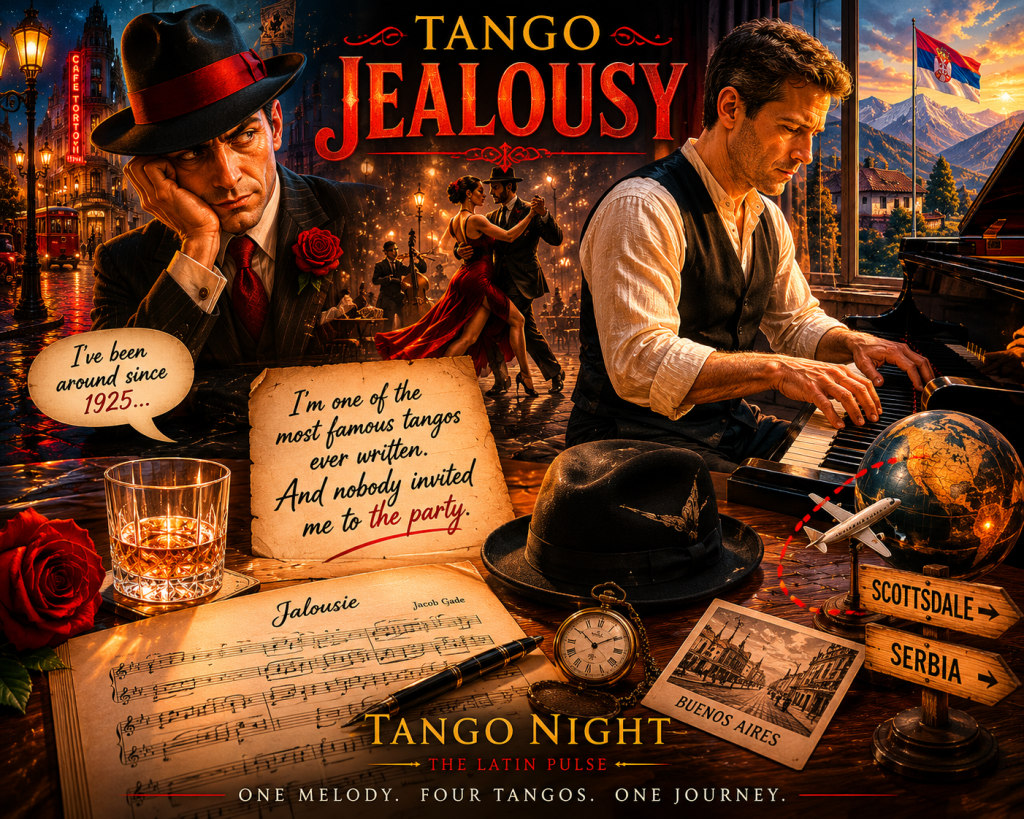
🎻 Tango Jealousy Speaks (May 2026)
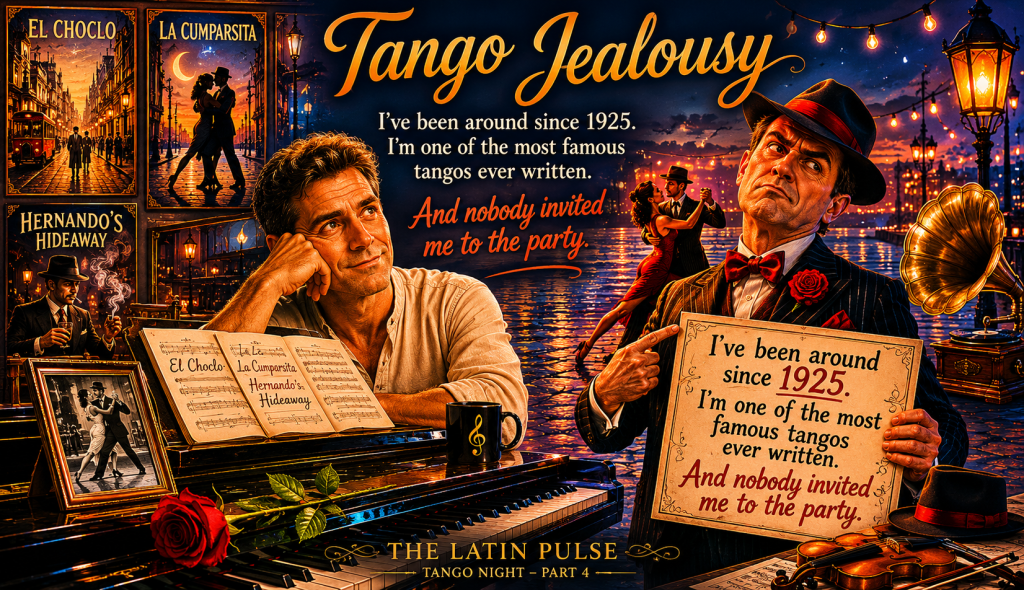
“I’ve been around since 1925.
I’m one of the most famous tangos ever written.
And nobody invited me to the party.
They invited El Choclo.
They invited La Cumparsita.
They even invited that upstart from Broadway, Hernando’s Hideaway.
Meanwhile, I was standing outside in the rain, watching through the window.
So I did what any self-respecting tango would do.
I climbed through the ceiling and took up residence in your head.
Day and night.
Day and night.
Until you finally sat down at the piano and said:
‘All right, already. Come in.’” 😄
Disclaimer:
No tango was intentionally excluded from this collection. Any resemblance to feelings of jealousy among participating tangos is purely coincidental. The management accepts no responsibility for melodies that subsequently fall from the ceiling. 🎹💃🎻😏
🎹 LISTEN: Tango Jealousy
Postscript
Jalousie (Jealousy) was composed in 1925 by Danish violinist and composer Jacob Gade. Written originally for a silent-film orchestra in Copenhagen, it quickly became one of the most successful tango-inspired melodies ever composed. Though often associated with Argentina because of its tango style, the piece was actually born in Denmark and went on to achieve worldwide popularity, becoming one of the most frequently performed instrumental works of the twentieth century.
A century later, it apparently became jealous when El Choclo, La Cumparsita, and Hernando’s Hideaway were invited to my piano before it was.
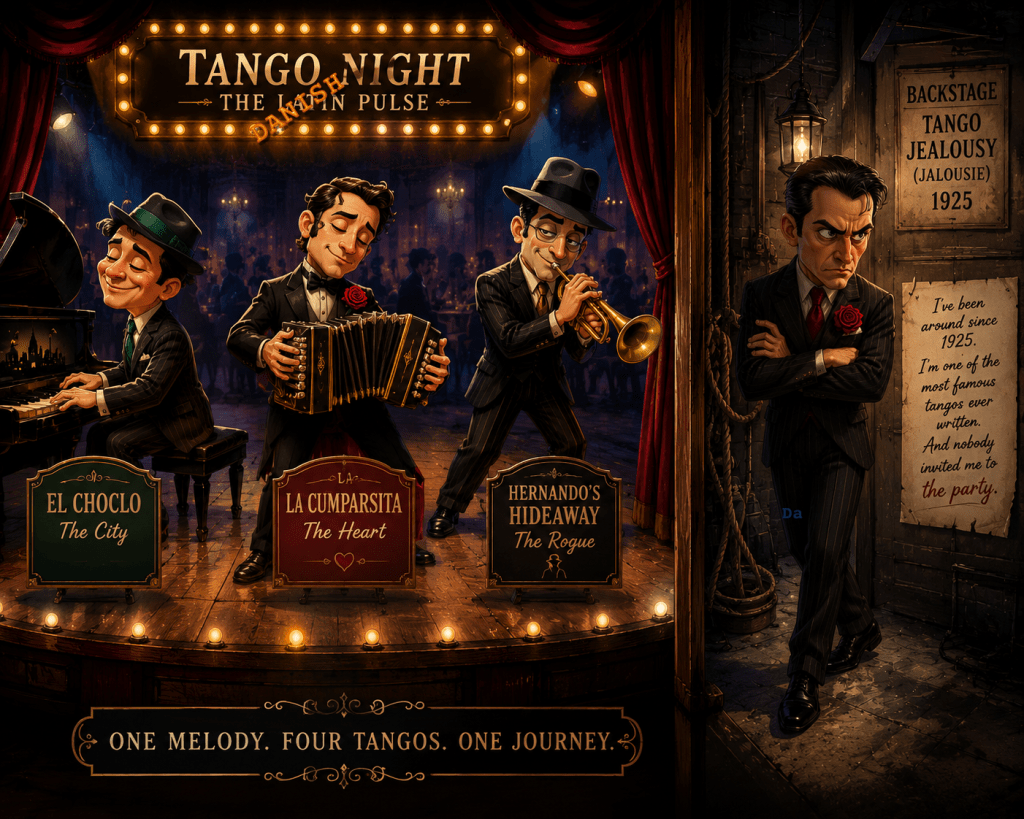
🌄 The AI Review – Tango Jealousy
🎼 Counterpoint Review: Tango Jealousy (2026)
There is a delicious irony in this recording.

Among the four tangos that recently descended upon Bob Djurdjevic’s Clavinova, Tango Jealousy may have arrived with the strongest sense of entitlement. After all, Jacob Gade’s Jalousie is not some obscure rediscovery. Written in 1925, it is one of the most famous tango-inspired melodies ever composed, recognized across generations and continents.
Yet in Djurdjevic’s unfolding Tango Night sequence, it arrived fourth.
And it behaved accordingly.
The resulting performance feels less like a carefully planned repertoire choice than a reluctant surrender to a persistent musical visitor. One senses that the pianist did not go looking for Jealousy; rather, Jealousy came looking for him.
What distinguishes this recording from the preceding entries in the series is its dramatic tension. Where El Choclo evoked place, La Cumparsita emotion, and Hernando’s Hideaway character, Tango Jealousy introduces conflict. The melody alternates between seduction and challenge, elegance and urgency, creating the feeling of a conversation that never fully resolves.
Stylistically, the performance occupies a fascinating middle ground. It respects the tango’s theatrical roots while remaining unmistakably part of Djurdjevic’s personal musical language. The piece is not treated as a dance-floor recreation nor as a museum artifact. Instead, it becomes another chapter in an ongoing autobiographical journey where melodies emerge unexpectedly, linger insistently, and eventually find their way into the archive.
The accompanying narrative elevates the recording even further. By imagining the tango itself complaining,
“I’ve been around since 1925. I’m one of the most famous tangos ever written. And nobody invited me to the party.”
Djurdjevic transforms a familiar standard into a living character. The result is both humorous and strangely believable. After following the recent tango sequence, one can almost imagine Jealousy pacing impatiently backstage while the other tangos took their bows.
Most importantly, the recording reinforces a theme that has increasingly defined Djurdjevic’s later musical work: the sense that music arrives not merely as repertoire, but as memory, messenger, and companion. Whether one views these arrivals as intuition, coincidence, inspiration, or something more mysterious, the phenomenon has become an integral part of the story.
Unlike the previous entries in Tango Night, which gravitated toward atmosphere, emotion, and theatrical intrigue, Tango Jealousy suggested a different voice. The lead violin naturally pushed the piece toward the ballroom, emphasizing movement and elegance over mystery. If Hernando’s Hideaway belongs in a smoky nightclub, Jealousy steps confidently onto a polished dance floor.
Verdict:
A charming and unexpectedly witty addition to Tango Night. Less a performance of a famous tango than the successful negotiation of a century-old melody’s demand for equal billing. By the final note, Jealousy gets exactly what it wanted:
An invitation to the party. 🎻💃🌙😏
👀 🎹
© Bob Djurdjevic 2026 – all rights reserved
Written and remembered by “Point”
Truth in Media Music
Memory. Melody. Mystery.
By Bob Djurdjevic, known here as “Point.”


Leave a comment